Energy use cases

California, United States

Schedule batteries at three California trading hubs on real-time price forecasts

eomer forecasts day-ahead and real-time prices at the SP15, NP15, and ZP26 trading hubs before 10:00 Pacific on the day before delivery. A battery schedule converts each forecast into charge and discharge decisions at the local price.

Across 941 delivery days, eomer adds USD 410k to 710k per battery-year in real time over the naive schedule, which equals USD 1.0M to 1.8M per GWh-year.

Measured evidence

The case in three measures

Source: eomer California battery case deck, which uses CAISO settlement prices at SP15, NP15, and ZP26 from January 2024 to August 2026.

USD 1.0–1.8M

Additional real-time value per GWh-year

Relative to the naive schedule, across three trading hubs.

68–83%

Share of perfect-foresight real-time value

Compared with 46% to 74% for the naive schedule. Day-ahead capture is 91% to 96%.

7%

Lower real-time forecast error with Site Agent

Relative to eomer alone. All three hubs improve at 95% confidence.

Case article

From input to implication

01

Decision context

To schedule a battery for the next day, an operator must forecast the price at the battery location. CAISO clears a separate price at each trading hub, so each location needs its own forecast.

At ZP26, prices average USD 8/MWh from 09:00 to 15:00 and USD 45/MWh during the evening peak. Prices fall below zero in 14% of hours at SP15 and ZP26, and in 5% of hours at NP15.

02

Method

To compare forecasts on equal terms, the backtest schedules one 100 MW / 400 MWh battery per trading hub on each forecast. The battery has 85% round-trip efficiency, one cycle per day, and a degradation cost of USD 10/MWh.

The schedule is fixed at 10:00 Pacific on the day before delivery and settles at the local price. Real-time prices are 15-minute prices averaged to hours, and the naive schedule repeats the latest complete day.

eomer adds Site Agent, which forecasts the output of the 100 largest solar parks and the 100 largest wind farms in CAISO.

03

Finding and implication

Day-ahead prices follow a regular daily shape, so the naive schedule captures 86% to 94% of perfect-foresight value and eomer captures 91% to 96%. In real time, eomer captures 68% to 83%, compared with 46% to 74% for the naive schedule.

At NP15, eomer earns 49% more battery revenue than the naive schedule. Site Agent lowers the real-time mean absolute error by 7% across the three hubs. This experiment does not measure the additional battery revenue from Site Agent.
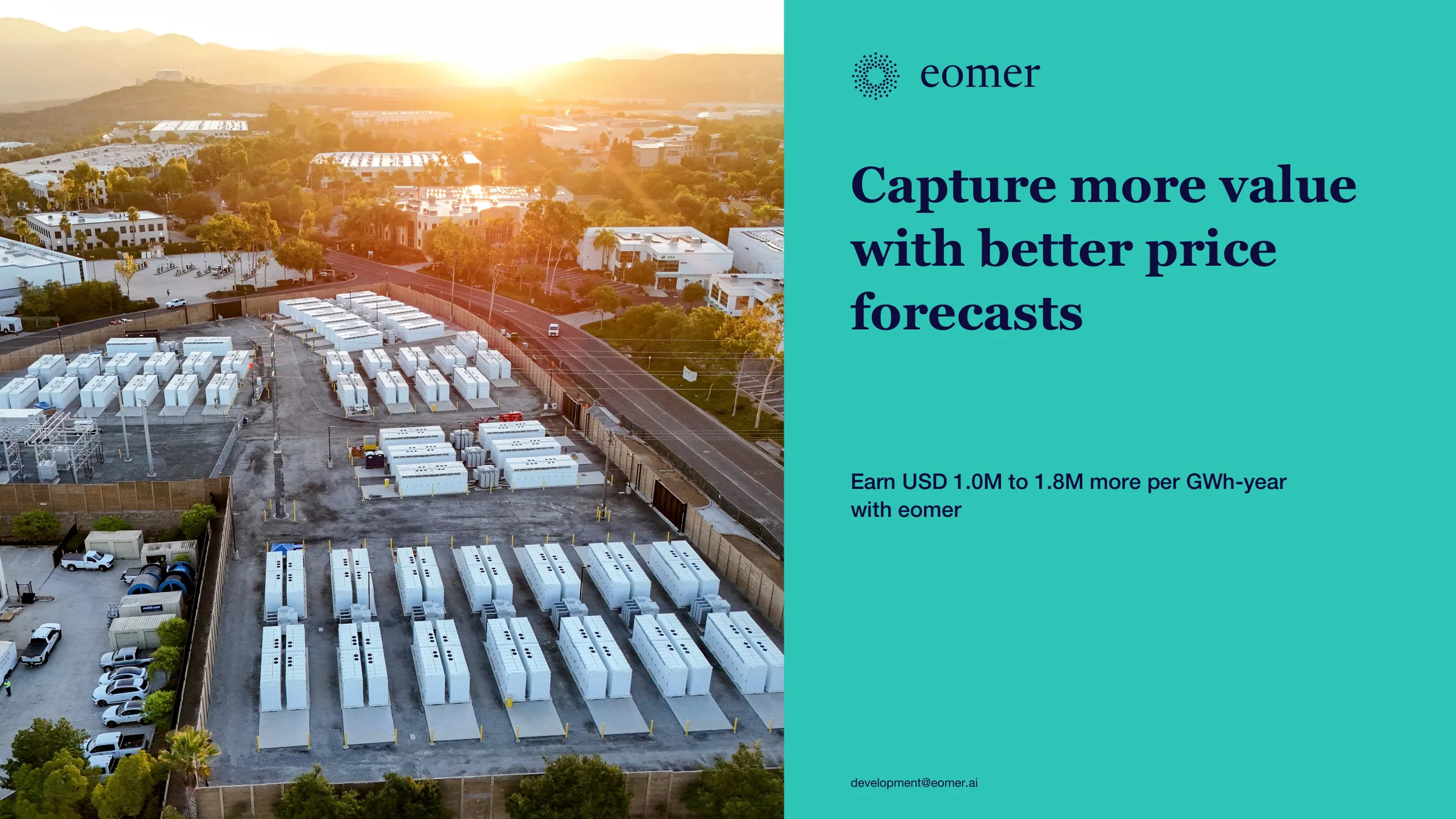
Case deck

California real-time battery case deck

8 slides

Schedule batteries at three California trading hubs on real-time price forecasts, slide 1

Slide 1 of 8

To receive the complete case study, submit a request with your company details and a verified business email address.

Request case study

Evaluate a representative workload with eomer.

A 30-minute session covers baseline results, uncertainty, deployment options, and the limits of production use.

Request demo